
Features
This function checks the difference between the current pose and the rotating angle range of the robot end effector. It returns the difference (in rad) between the current pose and the rotating angle range with the algorithm that transforms it to a rotation matrix using the “AngleAxis” technique. It returns True if the difference is positive (+) and False if the difference is negative (-). It is used to check if the difference between the current pose and the rotating angle range is + or -. For example, the function can be used to set the rotating angle range to min and max at any reference position, and then determine the orientation limit by checking if the difference from the current position is + or -. This condition can be repeated with the while or if statement.
-
Setting Min only: True if the difference is + and False if -
-
Setting Min and Max: True if the difference from min is - while the difference from max is + and False if the opposite.
-
Setting Max only: True if the maximum difference is + and False otherwise
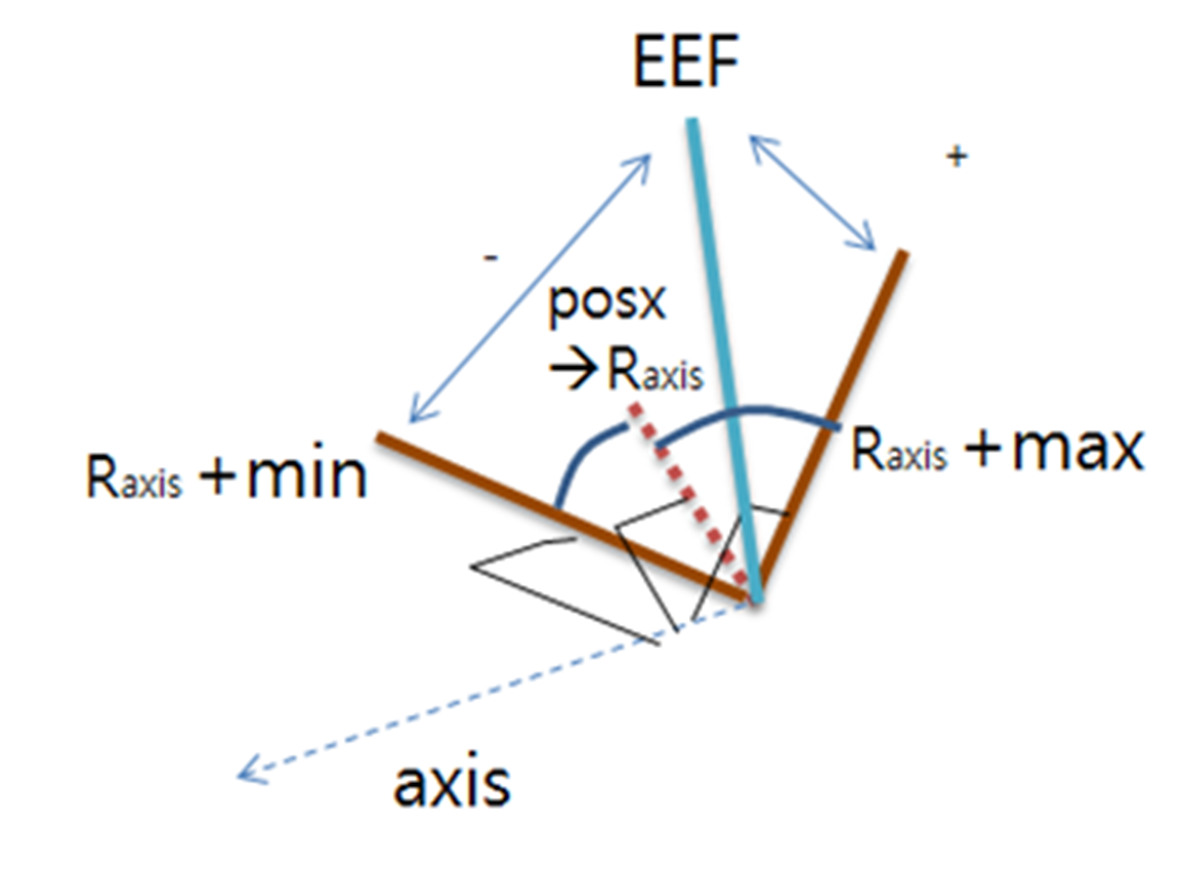
Range of rotating angle: This means the relative angle range (min, max) based on the specified axis from a given position based on the ref coordinate.
Parameter
|
Parameter Name |
Data Type |
Default Value |
Description |
|
eForceAxis |
enum.FORCE_AXIS |
- |
Refer to the Definition of Constant and Enumeration Type |
|
fTargetMin |
float |
- |
Minimum value |
|
fTargetMax |
float |
- |
Maximum value |
|
fTargetPos |
float[6] |
- |
Target task location for six axes |
|
eForceReference |
enum.COORDINATE_SYSTEM |
COORDINATE_SYSTEM_TOOL |
Refer to the Definition of Constant and Enumeration Type |
Return
|
Value |
Description |
|
1 |
The condition is True |
|
0 |
The condition is False |
Example
float posx1[6] = {400, 500, 800, 0, 180, 30};
bool con1 = Drfl.check_orientation_condition(FORCE_AXIS_C, 0, 5, posx1);