
The weight of the tool installed on the flange can be set by adding a tool weight Workcell Item. The Tool Weight can be set in Robot Parameters > Tool Settings > Tool Weight.
-
The tool weight can be measured using the auto measure function.
-
It is recommended to add tool weight as Workcell Items for each tool with a workpiece. If the workpiece weight is too heavy, the robot may recognize the weight of the workpiece as external force. It is because the robot determines this external force as a collision and stops.
-
When creating a task, change the weight Workcell Item according to the process to change the tool weight. For example, it is possible to configure a task to select the standard tool weight Workcell Item before picking up a workpiece, and select the tool weight Workcell Item with the workpiece after picking up a workpiece.
The activated tool weight Workcell Item can be set as the standard tool weight by pressing the set tool icon ( 
-
Set of the tool setting is the same as the set of Other Commands. Set command can be used when changing the Tool Weight while a task is being performed. For more information, refer to Task Editor Module.
-
Up to fifty different tool weights can be registered.
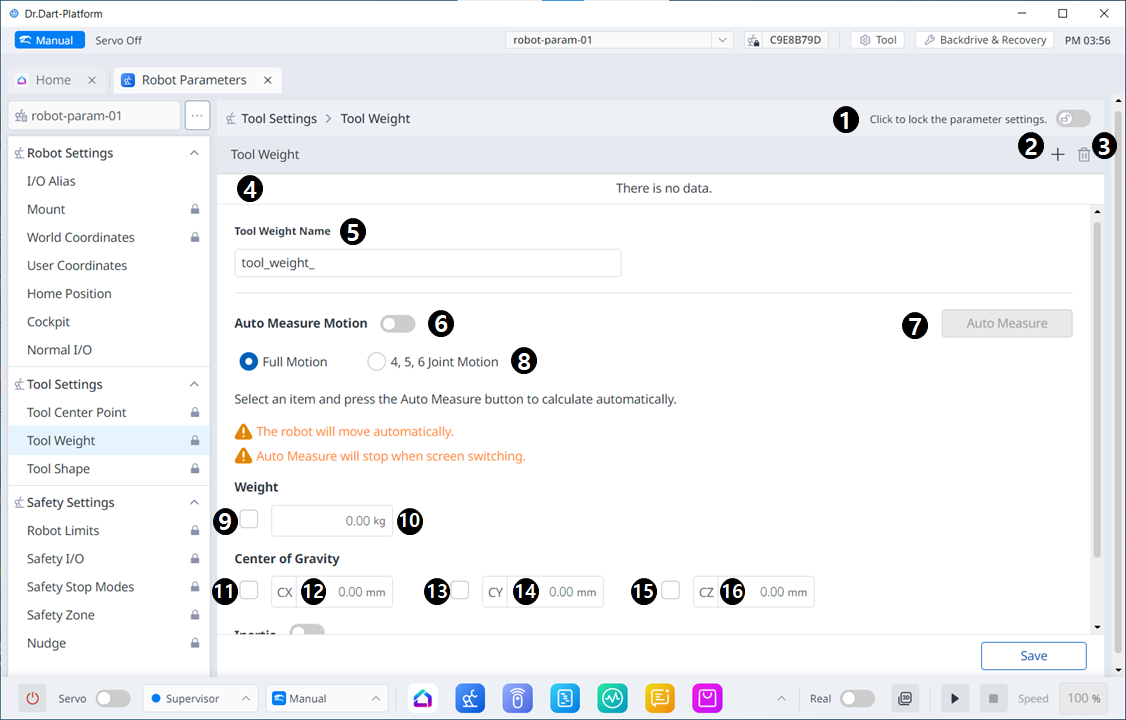
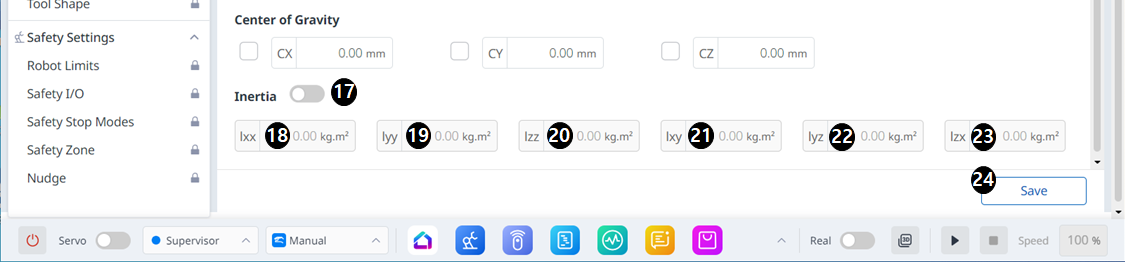
|
|
Item |
Description |
|---|---|---|
|
1 |
Lock Toggle Button |
Used to lock the set value. The safety password is required for modifying the set value. |
|
2 |
Adding |
This button allows you to add a new Tool Weight. |
|
3 |
Deleting |
This button allows you to delete a Tool Weight. |
|
4 |
Tool Weight List |
A list of the configured Tool Weights |
|
5 |
Tool Weight Name |
This is where you can enter a name for the Tool Weight. |
|
6 |
Auto Measure Motion |
This button allows you to run the automatic measurement. |
|
7 |
Automatic Measurement |
This button allows you to select an option and run an automatic measurement for it. |
|
8 |
Motion Selection |
You can select the desired Motion from the options. |
|
9 |
Selection of the Use of Weight |
You can choose whether to use weight. This selection box is disabled for E Series or A Series without FPT sensors. |
|
10 |
Weight Input |
This is where you can enter the desired weight. |
|
11 |
Selection of the Use of Center of Gravity CX |
The use of the center of gravity CX can be selected. |
|
12 |
CX Input |
CX can be entered. |
|
13 |
Selection of the Use of Center of Gravity CY |
The use of the center of gravity CY can be selected. |
|
14 |
CY Input |
CY can be entered. |
|
15 |
Selection of the Use of Center of Gravity CZ |
The use of the center of gravity CZ can be selected. |
|
16 |
CZ Input |
CZ can be entered. |
|
17 |
Whether to Use Inertia |
This checkbox allows you to choose whether to use inertia. |
|
18 |
lxx Input |
An LXX entry for inertia can be entered. |
|
19 |
lyy Input |
An lyy entry for inertia can be entered. |
|
20 |
lzz Input |
An lzz entry for inertia can be entered. |
|
21 |
lxy Input |
An lxy entry for inertia can be entered. |
|
22 |
lyz Input |
An lyz entry for inertia can be entered. |
|
23 |
lzx Input |
An lzx entry for inertia can be entered. |
|
24 |
Save |
This button allows you to save the setting values. |